Since making its public bow earlier this year at the High-End Vienna audio show, there’s been quite a buzz about the Luna Series from Abbingdon Music Research.
Built with the same ambition as supercars and haute horology, this luxury audio system sets a new high-end benchmark for British Audio.
Seven years in development, the trio – the Luna Ingenii DAC, Luna Medii preamplifier and Luna Procellarum monoblock amplifiers – are wildly ambitious.
Proprietary DAC architectures, battery-like power supplies, fully balanced FET amplifier topologies and ultra-rare components all feature prominently. We’re in rarified air here.
Production is strictly limited.
So when the opportunity came to experience the whole kit and caboodle at London’s prestigious Cornflake showroom, I didn’t hesitate.
Thankfully, the system lives up to the hype. The AMR Luna Series really does sound out of this world.
Which is just as well, given that it sells for around £540,000 (give or take)…
When the opportunity came to experience the whole kit and caboodle at London’s prestigious Cornflake showroom, I didn’t hesitate…
Inside Abbingdon Music Research’s Luna audio system
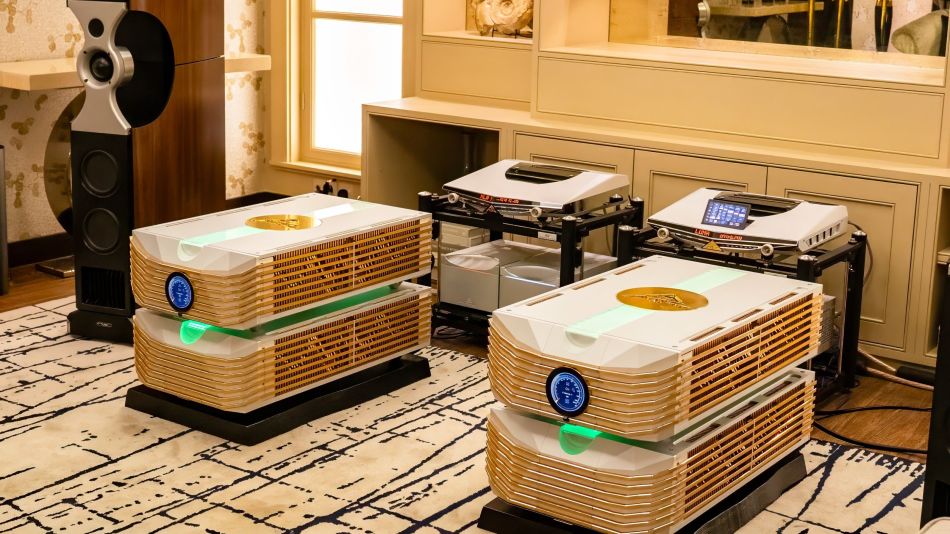
Handmade in Southport, alongside stablemate iFi Audio, the collection looks more akin to an avant garde art installation than traditional Hi-Fi.
Sweeping aluminium bodywork with gold accents identify the two monoblock amps, while the matching DAC and preamplifier channel classic automotive design.
The engineering beneath the metalwork is equally uncompromising.
Every aspect of the system has been pursued with almost obsessive attention to detail, under the auspices of American audio engineer John Curl (who has worked with a host of luxury audio brands over the years, as well as classic rock band, The Grateful Dead).
Each unit is individually calibrated and destined for a lifetime of factory support. Production numbers are less than 200 of each unit.
The Luna Procellarum monoblock amp employs what AMR casually describes as the world’s first commercially realised fully balanced four-quadrant FET amplifier architecture. Four complete amplifier circuits work together for each channel; the goal is greater linearity, tighter bass control and the elimination of crossover distortion.
The Luna Ingenii DAC takes an equally unconventional route. Most digital converters rely on a handful of integrated circuits. The Ingenii instead combines two legendary Philips TDA1541A multi-bit converters with eight Analog Devices AD1862 chips, supported by more than 700 individual components.
Alongside this sits AMR’s proprietary 128-stage Direct DSD ‘Stonehenge’ engine, itself built from 32 chips and hundreds more discrete parts. It’s extraordinarily complex. I’ve no doubt, in the future, much like its namesake, commentators will speculate on how it was made.
By constructing a true 32-bit multi-bit architecture rather than relying on conventional delta-sigma conversion, I’m told the system can achieve lower noise, greater linearity and more natural musical timing than pretty much anything else on the planet.
Owners can even alter the tonal character of playback using the company’s proprietary Bit-Gravity Harmonic Weighting system, which adjusts the relationship between the two different DAC architectures in real time at hardware level, rather than through digital signal processing.
Completing the trio is the Luna Medii preamplifier. Here, AMR has attempted to solve one of Hi-Fi’s oldest challenges: how to adjust volume without introducing unwanted artefacts. Conventional preamplifiers place potentiometers or resistor networks directly in the signal path. The Medii removes them entirely.
Its Zero In-Line Element Volume Control varies gain without inserting any component into the signal chain itself. The result, according to AMR, is the transparency of a direct electrical connection combined with precise volume adjustment. Most importantly, it also makes a vary satisfying ‘clicky’ sound.
Amplification comes courtesy of carefully matched NOS GE5670 valves, selected not for nostalgic warmth but for their ability to preserve tonal nuance and dynamic expression.
Rare components meet radical design
Throughout the Luna Series, the choice of materials borders on obsessive. Pure silver internal wiring is partnered with Audio Note Silver Tantalum resistors, custom Teflon capacitors, Exicon lateral MOSFET output devices, WBT NextGen silver connectors and carefully selected new-old-stock valves.
AMR says it spent years acquiring many of these components and, in several cases, the available global supply has now effectively been exhausted.
Power delivery receives the same level of scrutiny. The proprietary AirLock architecture electrically isolates each component from the incoming AC supply while delivering energy with battery-like impedance and active noise cancellation.
Listening to the Luna Series partnered with PMC’s flagship studio-grade loudspeakers, themselves costing around £80,000, I’m left in little doubt that all this extraordinary engineering has substance.
I listen to the system with a variety of musical genres. The system offers effortless dynamics and astonishing transparency. Bass is deep and tight, while highs are bright and crystalline. There’s an exhilarating, propulsive energy about the presentation.
Despite all the astonishing hardware at play, I found myself listening to the music, rather than the system, which ultimately must be the point.
I’m guessing buyers of the Luna Series are unlikely to pore over distortion figures or component counts. They’re investing in exceptional craftsmanship and rarity as much as measurable performance.
In truth, I didn’t get to spend long enough in Luna’s orbit, but that was always going to be the case.
Ultimately, the AMR Luna Series is an object of beauty, built without compromise. It also demonstrates just how far the pursuit of perfect sound can be taken when ambition is unfettered.
Swiss audio specialist Goldmund has unveiled the Mimesis Statement, a new flagship analogue pre-amplifier featuring a monolithic three-chassis design and exceptionally low measured distortion. The Mimesis Statement represents the company’s latest effort to preserve the integrity of an audio signal in a high-end stereo system. Its formidable £220,000 price tag places the Mimesis Statement firmly…
The Comu Action Pro is a pocket-sized AI voice recorder designed for those who spend much of their business life in meetings, interviews, and briefings. It combines audio capture with an AI assistant that can transcribe discussions, summarise key points and turn spoken instructions into editable working documents. I know what you’re thinking. A good…
Cambridge Audio is back on the turntable bandwagon with Spira, a stylish deck that combines straightforward vinyl playback, with Bluetooth connectivity and upgrade potential. Available in five colours, it’s aimed at vinyl newcomers building their first Hi-Fi system and established fans looking for a designer upgrade, and arrives ready to play, with a pre-fitted Audio-Technica…



Since making its public bow earlier this year at the High-End Vienna audio show, there’s been quite a buzz about the Luna Series from Abbingdon Music Research.
Built with the same ambition as supercars and haute horology, this luxury audio system sets a new high-end benchmark for British Audio.
Seven years in development, the trio – the Luna Ingenii DAC, Luna Medii preamplifier and Luna Procellarum monoblock amplifiers – are wildly ambitious.
Proprietary DAC architectures, battery-like power supplies, fully balanced FET amplifier topologies and ultra-rare components all feature prominently. We’re in rarified air here.
Production is strictly limited.
So when the opportunity came to experience the whole kit and caboodle at London’s prestigious Cornflake showroom, I didn’t hesitate.
Thankfully, the system lives up to the hype. The AMR Luna Series really does sound out of this world.
Which is just as well, given that it sells for around £540,000 (give or take)…
Inside Abbingdon Music Research’s Luna audio system
Handmade in Southport, alongside stablemate iFi Audio, the collection looks more akin to an avant garde art installation than traditional Hi-Fi.
Sweeping aluminium bodywork with gold accents identify the two monoblock amps, while the matching DAC and preamplifier channel classic automotive design.
The engineering beneath the metalwork is equally uncompromising.
Every aspect of the system has been pursued with almost obsessive attention to detail, under the auspices of American audio engineer John Curl (who has worked with a host of luxury audio brands over the years, as well as classic rock band, The Grateful Dead).
Each unit is individually calibrated and destined for a lifetime of factory support. Production numbers are less than 200 of each unit.
The Luna Procellarum monoblock amp employs what AMR casually describes as the world’s first commercially realised fully balanced four-quadrant FET amplifier architecture. Four complete amplifier circuits work together for each channel; the goal is greater linearity, tighter bass control and the elimination of crossover distortion.
The Luna Ingenii DAC takes an equally unconventional route. Most digital converters rely on a handful of integrated circuits. The Ingenii instead combines two legendary Philips TDA1541A multi-bit converters with eight Analog Devices AD1862 chips, supported by more than 700 individual components.
Alongside this sits AMR’s proprietary 128-stage Direct DSD ‘Stonehenge’ engine, itself built from 32 chips and hundreds more discrete parts. It’s extraordinarily complex. I’ve no doubt, in the future, much like its namesake, commentators will speculate on how it was made.
By constructing a true 32-bit multi-bit architecture rather than relying on conventional delta-sigma conversion, I’m told the system can achieve lower noise, greater linearity and more natural musical timing than pretty much anything else on the planet.
Owners can even alter the tonal character of playback using the company’s proprietary Bit-Gravity Harmonic Weighting system, which adjusts the relationship between the two different DAC architectures in real time at hardware level, rather than through digital signal processing.
Completing the trio is the Luna Medii preamplifier. Here, AMR has attempted to solve one of Hi-Fi’s oldest challenges: how to adjust volume without introducing unwanted artefacts. Conventional preamplifiers place potentiometers or resistor networks directly in the signal path. The Medii removes them entirely.
Its Zero In-Line Element Volume Control varies gain without inserting any component into the signal chain itself. The result, according to AMR, is the transparency of a direct electrical connection combined with precise volume adjustment. Most importantly, it also makes a vary satisfying ‘clicky’ sound.
Amplification comes courtesy of carefully matched NOS GE5670 valves, selected not for nostalgic warmth but for their ability to preserve tonal nuance and dynamic expression.
Rare components meet radical design
Throughout the Luna Series, the choice of materials borders on obsessive. Pure silver internal wiring is partnered with Audio Note Silver Tantalum resistors, custom Teflon capacitors, Exicon lateral MOSFET output devices, WBT NextGen silver connectors and carefully selected new-old-stock valves.
AMR says it spent years acquiring many of these components and, in several cases, the available global supply has now effectively been exhausted.
Power delivery receives the same level of scrutiny. The proprietary AirLock architecture electrically isolates each component from the incoming AC supply while delivering energy with battery-like impedance and active noise cancellation.
Listening to the Luna Series partnered with PMC’s flagship studio-grade loudspeakers, themselves costing around £80,000, I’m left in little doubt that all this extraordinary engineering has substance.
I listen to the system with a variety of musical genres. The system offers effortless dynamics and astonishing transparency. Bass is deep and tight, while highs are bright and crystalline. There’s an exhilarating, propulsive energy about the presentation.
Despite all the astonishing hardware at play, I found myself listening to the music, rather than the system, which ultimately must be the point.
I’m guessing buyers of the Luna Series are unlikely to pore over distortion figures or component counts. They’re investing in exceptional craftsmanship and rarity as much as measurable performance.
In truth, I didn’t get to spend long enough in Luna’s orbit, but that was always going to be the case.
Ultimately, the AMR Luna Series is an object of beauty, built without compromise. It also demonstrates just how far the pursuit of perfect sound can be taken when ambition is unfettered.
For more, visit Abbingdon Music Research here.
Goldmund Mimesis Statement pre-amp puts power-supply isolation at the heart of luxury audio
Swiss audio specialist Goldmund has unveiled the Mimesis Statement, a new flagship analogue pre-amplifier featuring a monolithic three-chassis design and exceptionally low measured distortion. The Mimesis Statement represents the company’s latest effort to preserve the integrity of an audio signal in a high-end stereo system. Its formidable £220,000 price tag places the Mimesis Statement firmly…
Comu Action Pro review: This AI voice recorder is a smarter way to capture meetings
The Comu Action Pro is a pocket-sized AI voice recorder designed for those who spend much of their business life in meetings, interviews, and briefings. It combines audio capture with an AI assistant that can transcribe discussions, summarise key points and turn spoken instructions into editable working documents. I know what you’re thinking. A good…
Colourful Cambridge Audio Spira Bluetooth turntable wants to win over vinyl newbies
Cambridge Audio is back on the turntable bandwagon with Spira, a stylish deck that combines straightforward vinyl playback, with Bluetooth connectivity and upgrade potential. Available in five colours, it’s aimed at vinyl newcomers building their first Hi-Fi system and established fans looking for a designer upgrade, and arrives ready to play, with a pre-fitted Audio-Technica…
Share this: