After nearly a decade of development, Midleton Very Rare Irish Chestnut Edition marks the debut release in the distillery’s new Rare Wood Collection and the first Midleton whiskey finished in casks made entirely from Irish sweet chestnut sourced from County Waterford’s Cappoquin Estate.
Crafted from select Single Pot Still whiskeys initially matured in bourbon casks before spending five years in bespoke chestnut hogsheads, the liquid is bottled at a natural cask strength of 56.1% ABV.
The Luxe Review was invited to taste the whiskey at its official unveiling, held in a wooded clearing on the Cappoquin Estate itself, an evocative setting for a release so closely connected to its raw materials.
A woodland trail led us to a clearing where the stumps of two felled chestnut trees served as plinths for the finished bottle. One of the casks used in the maturation stood nearby, holding the first pours of the whiskey.
The presentation was theatrical, but the setting made perfect sense. Here was a whiskey whose identity had been shaped by six trees from the surrounding landscape. The launch offered a unique opportunity to explore the finished spirit and examine the component distillates that helped create it…
A woodland trail led us to a clearing where the stumps of two felled chestnut trees served as plinths for the finished bottle…
Midleton Very Rare Irish Chestnut Edition tasting notes
Midleton Very Rare Irish Chestnut Edition is a luxurious whiskey of considerable richness and complexity.
The expression opens with aromas of fairground toffee apples and caramelised orange peel, with chocolate and fudge contributing a richer, confectionery back note. There’s also an undercurrent of nutmeg and cinnamon, and warming spices.
On the palate, orchard fruits and subtle citrus sail into waves of vanilla and sweet chocolate orange. Soft wood tannins sit alongside the familiar pot still spices. There are notes of clove, pepper and wood spices, attributed to wood-derived guaiacol. A mild prickle of chilli oil adds to its full-bodied texture. There’s flavour upon flavour.
The finish sees the fruit gradually fade, leaving pot still spice and chestnut wood to linger.
The making of Midleton Very Rare Irish Chestnut Edition
Wood has always been central to whisky and whiskey maturation. It influences colour, aroma, texture and flavour, with the character of a cask shaped by its species, preparation, previous contents and the conditions in which the spirit matures.
Oak remains the standard for much of the industry, while Irish whiskey regulations permit maturation in wooden casks more broadly. That flexibility creates room for intruing experimentation.
Chestnut has a history of use in European wine and spirits production. Its availability was severely reduced by chestnut blight during the middle decades of the 20th century, however, making suitable timber harder to find. Midleton had already explored French sweet chestnut for its Method and Madness range, including a release in 2017, followed by a Japanese chestnut-cask expression in 2020. Those projects pointed to how the wood could influence the spirit.
For its Irish Chestnut Edition, the ambition was more specific: find suitable Irish sweet chestnut and use it to finish a whiskey worthy of the Midleton Very Rare name.
Forestry consultant Paddy Purser worked with Master Distiller Kevin O’Gorman and Master Cooper Ger Buckley to identify the trees. Six were selected from the carefully managed woodland of Cappoquin Estate, where the Keane family has lived since 1735. The trees were duly felled November 2017.
The timber then embarked on its own journey. The logs were quarter-sawn in Galicia, in north-west Spain, and the staves were air-dried for 15 to 16 months. They were subsequently made into 240-litre hogsheads by the Tonelería Antonio Páez Lobato cooperage in Jerez. A medium toast prepared the casks for their role in shaping the whiskey.
It’s a process that unites Irish forestry with traditional Spanish coopering. The trees grew in County Waterford, but turning their timber into functional maturation vessels required specialist knowledge and considerable patience.
The casks were filled with a bespoke blend of Midleton Single Pot Still whiskeys that had already matured in first-fill and refill bourbon barrels. The initial maturation ranged from 12 to 19 years, with O’Gorman indicating that some of the liquid may have been as old as 24 years.
The blend draws on light, medium and heavier styles of Single Pot Still whiskey, brought together in roughly equal proportions, with additional traditional pot still whiskey used for balance.
Genesis of Midleton Very Rare’s Chestnut Edition
Prior to the unveiling, we were invited to taste the three distillate styles,during a visit to the Midleton Micro Distillery, hosted by maturation expert Eric Ryan.
It was an illuminating exercise! The samples gave a fascinating glimpse into how the different elements contribute to the final blend, and how the chestnut cask contributes character. O’Gorman describes the heavier new make style as Midleton’s “secret sauce”.
The choice of wood itself presented a challenge. Chestnut is more porous and less dense than traditional oak, encouraging a more rapid interaction between the cask and the spirit. During the first year or two, the whiskey gained significant colour and tannin, reports O’Gorman, with the wood making its presence felt early in the maturation.
The subsequent years allowed the whiskey to settle and mellow. The full finishing period lasted five years, giving the spirit time to integrate the chestnut’s influence and develop a more harmonious profile.
As O’Gorman explained: “Chestnut matures fairly quickly. So you got a significant colour contribution from chestnut, a lot of tannins. You have to keep a very close eye on it.”
The experiment was not without its costs. The increased interaction between wood and spirit also contributed to evaporation, with a larger share lost to the angels. “I think it was 29 per cent over five years,” O’Gorman tells me. “It’s probably double what oak gives you, so huge losses.”
That said, Midleton has announced a global allocation of 800 case equivalents, which probably equates to something like 9,000 bottles.
The distillery has indicated that the chestnut casks may eventually find a further role in a special-edition Jameson release, but there will be no more iterations of this release, making this Midleton Very Rare expression a particularly desirable addition to its lauded portfolio.
The Macallan has just announced the Carta Nautica Collection, a new four-bottle series of single malt whiskies. As befits its Spanish moniker, Carta Nautica follows the journey of oak from North America to Jerez de la Frontera in Spain and onwards to Scotland. The collection draws on casks that have held bourbon and sherry, with…
Ah, brunch. Breakfast’s more sociable cousin, the only acceptable way to order a cocktail before noon: there’s no doubt in our mind that it’s the most important meal of the day. And you can forget eggs and coffee – London’s best spots make a strong case for dedicating the whole afternoon to our favourite event…
Indian whisky producer Indri has launched its Diwali Collector’s Edition 2026, a cask-strength single malt matured in Portuguese Ruby Port casks, with just 180 individually numbered bottles allocated to the UK. Bottled at 58.5% ABV, the new expression combines ripe red and dark fruit character with honey, nuts and warming spice. Produced by Piccadily Agro…

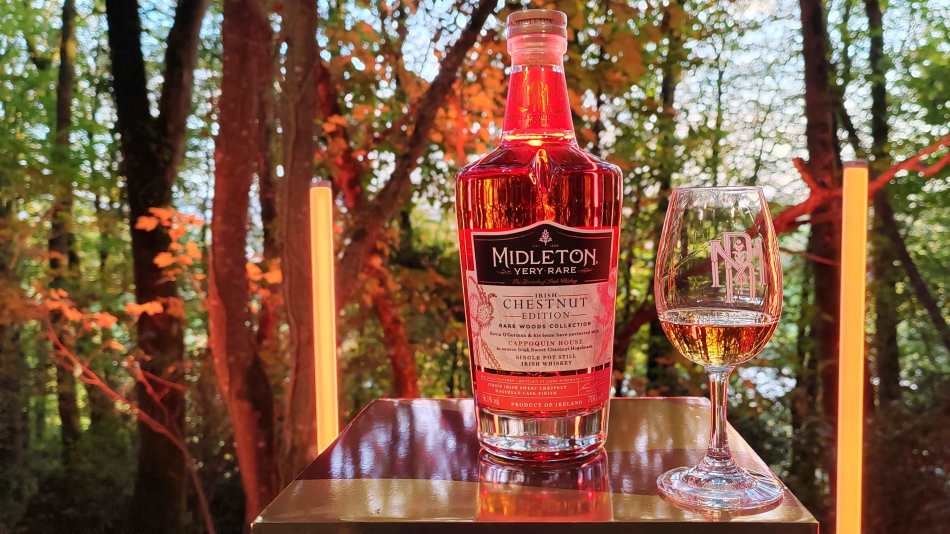


After nearly a decade of development, Midleton Very Rare Irish Chestnut Edition marks the debut release in the distillery’s new Rare Wood Collection and the first Midleton whiskey finished in casks made entirely from Irish sweet chestnut sourced from County Waterford’s Cappoquin Estate.
Crafted from select Single Pot Still whiskeys initially matured in bourbon casks before spending five years in bespoke chestnut hogsheads, the liquid is bottled at a natural cask strength of 56.1% ABV.
The Luxe Review was invited to taste the whiskey at its official unveiling, held in a wooded clearing on the Cappoquin Estate itself, an evocative setting for a release so closely connected to its raw materials.
A woodland trail led us to a clearing where the stumps of two felled chestnut trees served as plinths for the finished bottle. One of the casks used in the maturation stood nearby, holding the first pours of the whiskey.
The presentation was theatrical, but the setting made perfect sense. Here was a whiskey whose identity had been shaped by six trees from the surrounding landscape. The launch offered a unique opportunity to explore the finished spirit and examine the component distillates that helped create it…
Midleton Very Rare Irish Chestnut Edition tasting notes
Midleton Very Rare Irish Chestnut Edition is a luxurious whiskey of considerable richness and complexity.
The expression opens with aromas of fairground toffee apples and caramelised orange peel, with chocolate and fudge contributing a richer, confectionery back note. There’s also an undercurrent of nutmeg and cinnamon, and warming spices.
On the palate, orchard fruits and subtle citrus sail into waves of vanilla and sweet chocolate orange. Soft wood tannins sit alongside the familiar pot still spices. There are notes of clove, pepper and wood spices, attributed to wood-derived guaiacol. A mild prickle of chilli oil adds to its full-bodied texture. There’s flavour upon flavour.
The finish sees the fruit gradually fade, leaving pot still spice and chestnut wood to linger.
The making of Midleton Very Rare Irish Chestnut Edition
Wood has always been central to whisky and whiskey maturation. It influences colour, aroma, texture and flavour, with the character of a cask shaped by its species, preparation, previous contents and the conditions in which the spirit matures.
Oak remains the standard for much of the industry, while Irish whiskey regulations permit maturation in wooden casks more broadly. That flexibility creates room for intruing experimentation.
Chestnut has a history of use in European wine and spirits production. Its availability was severely reduced by chestnut blight during the middle decades of the 20th century, however, making suitable timber harder to find. Midleton had already explored French sweet chestnut for its Method and Madness range, including a release in 2017, followed by a Japanese chestnut-cask expression in 2020. Those projects pointed to how the wood could influence the spirit.
For its Irish Chestnut Edition, the ambition was more specific: find suitable Irish sweet chestnut and use it to finish a whiskey worthy of the Midleton Very Rare name.
Forestry consultant Paddy Purser worked with Master Distiller Kevin O’Gorman and Master Cooper Ger Buckley to identify the trees. Six were selected from the carefully managed woodland of Cappoquin Estate, where the Keane family has lived since 1735. The trees were duly felled November 2017.
The timber then embarked on its own journey. The logs were quarter-sawn in Galicia, in north-west Spain, and the staves were air-dried for 15 to 16 months. They were subsequently made into 240-litre hogsheads by the Tonelería Antonio Páez Lobato cooperage in Jerez. A medium toast prepared the casks for their role in shaping the whiskey.
It’s a process that unites Irish forestry with traditional Spanish coopering. The trees grew in County Waterford, but turning their timber into functional maturation vessels required specialist knowledge and considerable patience.
The casks were filled with a bespoke blend of Midleton Single Pot Still whiskeys that had already matured in first-fill and refill bourbon barrels. The initial maturation ranged from 12 to 19 years, with O’Gorman indicating that some of the liquid may have been as old as 24 years.
The blend draws on light, medium and heavier styles of Single Pot Still whiskey, brought together in roughly equal proportions, with additional traditional pot still whiskey used for balance.
Genesis of Midleton Very Rare’s Chestnut Edition
Prior to the unveiling, we were invited to taste the three distillate styles,during a visit to the Midleton Micro Distillery, hosted by maturation expert Eric Ryan.
It was an illuminating exercise! The samples gave a fascinating glimpse into how the different elements contribute to the final blend, and how the chestnut cask contributes character. O’Gorman describes the heavier new make style as Midleton’s “secret sauce”.
The choice of wood itself presented a challenge. Chestnut is more porous and less dense than traditional oak, encouraging a more rapid interaction between the cask and the spirit. During the first year or two, the whiskey gained significant colour and tannin, reports O’Gorman, with the wood making its presence felt early in the maturation.
The subsequent years allowed the whiskey to settle and mellow. The full finishing period lasted five years, giving the spirit time to integrate the chestnut’s influence and develop a more harmonious profile.
As O’Gorman explained: “Chestnut matures fairly quickly. So you got a significant colour contribution from chestnut, a lot of tannins. You have to keep a very close eye on it.”
The experiment was not without its costs. The increased interaction between wood and spirit also contributed to evaporation, with a larger share lost to the angels. “I think it was 29 per cent over five years,” O’Gorman tells me. “It’s probably double what oak gives you, so huge losses.”
That said, Midleton has announced a global allocation of 800 case equivalents, which probably equates to something like 9,000 bottles.
The distillery has indicated that the chestnut casks may eventually find a further role in a special-edition Jameson release, but there will be no more iterations of this release, making this Midleton Very Rare expression a particularly desirable addition to its lauded portfolio.
Midleton Very Rare Irish Chestnut Edition is priced at £350 and is available from The Whisky Exchange here.
The Macallan Carta Nautica Collection charts a new course for Scotch whisky icon, led by a 38 Year Old
The Macallan has just announced the Carta Nautica Collection, a new four-bottle series of single malt whiskies. As befits its Spanish moniker, Carta Nautica follows the journey of oak from North America to Jerez de la Frontera in Spain and onwards to Scotland. The collection draws on casks that have held bourbon and sherry, with…
The Best Bottomless Brunches in London Worth Getting Out of Bed For
Ah, brunch. Breakfast’s more sociable cousin, the only acceptable way to order a cocktail before noon: there’s no doubt in our mind that it’s the most important meal of the day. And you can forget eggs and coffee – London’s best spots make a strong case for dedicating the whole afternoon to our favourite event…
Indri celebrates Diwali with a Ruby Port Cask Indian Single Malt rich in fruit, honey and spice
Indian whisky producer Indri has launched its Diwali Collector’s Edition 2026, a cask-strength single malt matured in Portuguese Ruby Port casks, with just 180 individually numbered bottles allocated to the UK. Bottled at 58.5% ABV, the new expression combines ripe red and dark fruit character with honey, nuts and warming spice. Produced by Piccadily Agro…
Share this: