For decades, luxury air travel has meant thinking big: A380s, private suites, champagne lounges, vast first-class cabins, even on-board showers. The next chapter though, could be about thinking smaller.
It is very likely you will have flown on the A320 family of aircraft with BA or a budget airline, it’s the workhorse of European short-haul aviation.
The latest version of the aircraft however is making a real mark across the skies.
The Airbus A321XLR is still the recognisable narrow-body aircraft but with the ability to carry more fuel, giving it much longer range.
With the ability to go long-haul, airlines are adding lie-flat beds, private suites and premium service on routes once considered too small for a wide-body jet.
It is quite a leap for an aircraft most of us associate with a quick hop to Barcelona or Berlin. The XLR can fly for up to 11 hours and as far as 4,700 nautical miles. Suddenly, a plane that looks like the aircraft you take to Malaga can cross the Atlantic.
With the ability to go long-haul, airlines are adding lie-flat beds, private suites and premium service…
Flying like a rock star
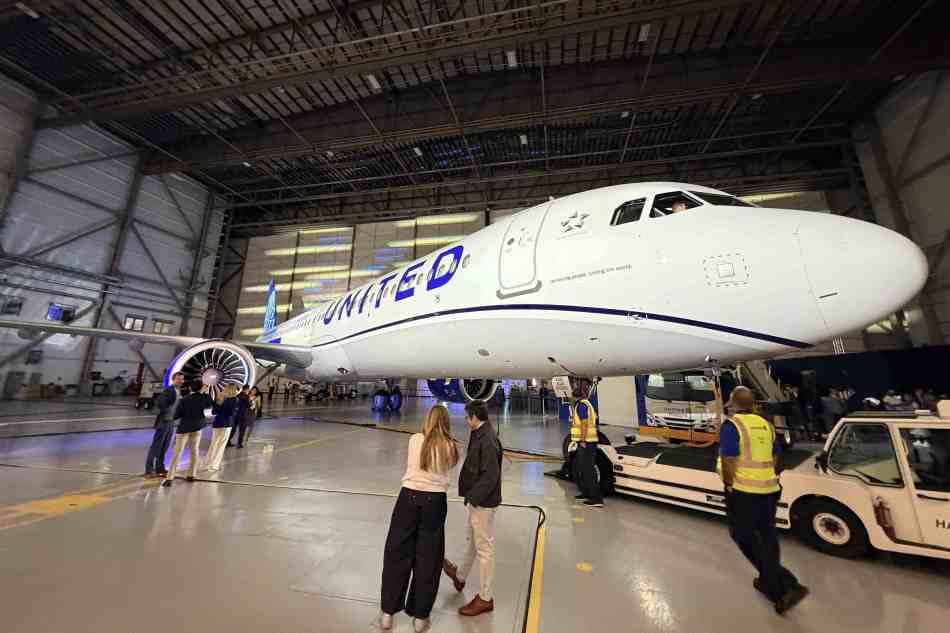
In a huge hangar at Newark Liberty International Airport in New Jersey I went to see a brand new, gleaming United Airlines A321XLR – lit up like a rock star. Journalists and aviation enthusiasts posed for photos next to the fuselage.
This glitzy event was designed to highlight United Airlines’ belief that this narrow body jet is going to play a big role in how we fly in the coming years. They have ordered 50, with more to come.
United’s Executive Vice President and Chief Commercial Officer, Andrew Nocella, described the new Polaris suite in the business cabin as having “been designed specifically to create a widebody experience on a narrowbody aircraft.”
Inside the Airbus A321XLR
I head on board and there’s a distinctive “new plane” smell. The interior – certainly at the front – reminds me of a private jet but on a bigger scale. There’s an unusually premium feel for a single-aisle jet: 20 lie-flat Polaris suites, each with a privacy door, alongside 12 Premium Plus seats. That’s 32 premium seats in total, 16 more than the Boeing 757-200 it is replacing.
The spacious Polaris suites are in a 1-1 configuration, so everyone has direct aisle access. They have 19-inch 4K OLED screens, a smart reading light, adjustable lumbar support and wireless charging. It is an intimate, quietly premium cabin in an aircraft small enough to reach places the giants can’t.
And that is perhaps the most intriguing luxury element. Not the suite itself but where the aircraft can take you.
United is deploying its A321XLR on new non-stop routes from the US to destinations including Ibiza, Luxembourg, Marseille, Toulouse and Valencia, destinations that historically have been more likely to require a connection through a major European hub.
Going direct is a luxury in itself, bypassing the mega-hubs and arriving closer to where you actually want to be.
For all the premium feel there are downsides. There’s no first class and walking down the single aisle can be an issue if you are trying to get to the toilet or stretch your legs and meet a member of the cabin crew pushing a trolley.
Where to fly the Airbus A321XLR
Britain has yet to fully embrace the A321XLR as a premium long-haul aircraft.
Wizz Air UK flies it from Gatwick, but its XLR’s are configured entirely for economy.
For a taste of what the XLR can offer in comfort you have to look across the Irish Sea to Aer Lingus, only the second airline in the world to receive the A321XLR. Or Iberia which uses XLRs on a number of transatlantic routes. American Airlines is flying the XLR from Edinburgh to JFK.
Perhaps that is the real benefit of the XLR. Not having the biggest cabin, the biggest aircraft or the biggest seat, but having the shortest possible journey between where you are and where you actually want to be.
In modern air travel, time and convenience might be the ultimate luxury.
British Airways is giving its long-haul cabins a substantial makeover, with new seats, bedding, dining and interiors arriving across its A380 fleet. Sean Doyle, Chairman and CEO at British Airways, says the upgrades mark “one of the most significant transformations we’ve ever undertaken on any aircraft. This is a major milestone for British Airways and…
JBL is hoping to shake up the whole-home Wi-Fi audio market with JBL Cove, a three-speaker system designed to make multi-room listening intuitive and expandable. Built around JBL’s own wireless platform and the JBL One app, the inaugural range comprises the compact Cove M1, portable Cove P1 and flagship Cove X1. Each speaker can operate…
Bose is bringing noise cancellation to wired earbuds with a fashionable new USB-C model that needs no Bluetooth pairing or charging. The launch comes as interest in wired listening booms. The new buds combine a direct USB-C connection with proprietary QuietControl noise cancellation and a built-in microphone system designed for clearer calls. There’s no Bluetooth…



For decades, luxury air travel has meant thinking big: A380s, private suites, champagne lounges, vast first-class cabins, even on-board showers. The next chapter though, could be about thinking smaller.
It is very likely you will have flown on the A320 family of aircraft with BA or a budget airline, it’s the workhorse of European short-haul aviation.
The latest version of the aircraft however is making a real mark across the skies.
The Airbus A321XLR is still the recognisable narrow-body aircraft but with the ability to carry more fuel, giving it much longer range.
With the ability to go long-haul, airlines are adding lie-flat beds, private suites and premium service on routes once considered too small for a wide-body jet.
It is quite a leap for an aircraft most of us associate with a quick hop to Barcelona or Berlin. The XLR can fly for up to 11 hours and as far as 4,700 nautical miles. Suddenly, a plane that looks like the aircraft you take to Malaga can cross the Atlantic.
Flying like a rock star
In a huge hangar at Newark Liberty International Airport in New Jersey I went to see a brand new, gleaming United Airlines A321XLR – lit up like a rock star. Journalists and aviation enthusiasts posed for photos next to the fuselage.
This glitzy event was designed to highlight United Airlines’ belief that this narrow body jet is going to play a big role in how we fly in the coming years. They have ordered 50, with more to come.
United’s Executive Vice President and Chief Commercial Officer, Andrew Nocella, described the new Polaris suite in the business cabin as having “been designed specifically to create a widebody experience on a narrowbody aircraft.”
Inside the Airbus A321XLR
I head on board and there’s a distinctive “new plane” smell. The interior – certainly at the front – reminds me of a private jet but on a bigger scale. There’s an unusually premium feel for a single-aisle jet: 20 lie-flat Polaris suites, each with a privacy door, alongside 12 Premium Plus seats. That’s 32 premium seats in total, 16 more than the Boeing 757-200 it is replacing.
The spacious Polaris suites are in a 1-1 configuration, so everyone has direct aisle access. They have 19-inch 4K OLED screens, a smart reading light, adjustable lumbar support and wireless charging. It is an intimate, quietly premium cabin in an aircraft small enough to reach places the giants can’t.
And that is perhaps the most intriguing luxury element. Not the suite itself but where the aircraft can take you.
United is deploying its A321XLR on new non-stop routes from the US to destinations including Ibiza, Luxembourg, Marseille, Toulouse and Valencia, destinations that historically have been more likely to require a connection through a major European hub.
Going direct is a luxury in itself, bypassing the mega-hubs and arriving closer to where you actually want to be.
For all the premium feel there are downsides. There’s no first class and walking down the single aisle can be an issue if you are trying to get to the toilet or stretch your legs and meet a member of the cabin crew pushing a trolley.
Where to fly the Airbus A321XLR
Britain has yet to fully embrace the A321XLR as a premium long-haul aircraft.
Wizz Air UK flies it from Gatwick, but its XLR’s are configured entirely for economy.
For a taste of what the XLR can offer in comfort you have to look across the Irish Sea to Aer Lingus, only the second airline in the world to receive the A321XLR. Or Iberia which uses XLRs on a number of transatlantic routes. American Airlines is flying the XLR from Edinburgh to JFK.
Perhaps that is the real benefit of the XLR. Not having the biggest cabin, the biggest aircraft or the biggest seat, but having the shortest possible journey between where you are and where you actually want to be.
In modern air travel, time and convenience might be the ultimate luxury.
First look: British Airways unveils new First, Club Suite and Economy cabins for A380
British Airways is giving its long-haul cabins a substantial makeover, with new seats, bedding, dining and interiors arriving across its A380 fleet. Sean Doyle, Chairman and CEO at British Airways, says the upgrades mark “one of the most significant transformations we’ve ever undertaken on any aircraft. This is a major milestone for British Airways and…
First listen: Versatile JBL Cove wireless speakers take whole-home audio beyond the living room
JBL is hoping to shake up the whole-home Wi-Fi audio market with JBL Cove, a three-speaker system designed to make multi-room listening intuitive and expandable. Built around JBL’s own wireless platform and the JBL One app, the inaugural range comprises the compact Cove M1, portable Cove P1 and flagship Cove X1. Each speaker can operate…
Bose brings noise cancelling to wired earbuds with trendy new USB-C earphones
Bose is bringing noise cancellation to wired earbuds with a fashionable new USB-C model that needs no Bluetooth pairing or charging. The launch comes as interest in wired listening booms. The new buds combine a direct USB-C connection with proprietary QuietControl noise cancellation and a built-in microphone system designed for clearer calls. There’s no Bluetooth…
Share this: