It opens with a roaring engine and a squeal of tires. As it should.
F1 the Movie, the long-anticipated racing drama from Top Gun: Maverick director Joseph Kosinski, doesn’t waste time pulling you into the cockpit: there’s no formation lap. Engine noise isn’t just sound design – it’s narrative. For the best part of two hours, you’re travelling at 220 km/h.
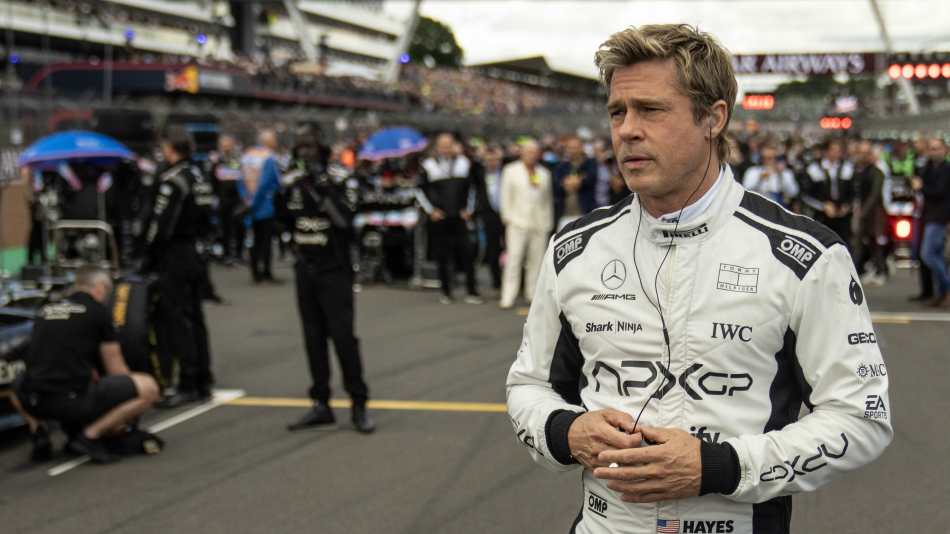
Brad Pitt, in a role that walks the fine line between charming rogue and weathered veteran, plays Sonny Hayes, a former Formula 1 prodigy whose career stalled in the ‘90s after a devastating crash.
Now a race-for-hire nomad of the lower leagues, he’s drawn back to the big show by his old teammate-turned-team owner Ruben Cervantes (played with rakish flair by Javier Bardem). The pitch? Come and race for APXGP, a struggling team in need of a miracle.
What follows is a spectacle that hits all the expected marks – but with technical panache and an insider’s eye that elevates it above cliché.
What follows is a spectacle that hits all the expected marks – but with technical panache that elevates it above cliché…
The Luxe Review caught up with director Joseph Kosinski, at Sony Pictures Studios in Culver City, during the production of F1 the Movie.
Speaking alongside cinematographer Claudio Miranda, he described the technical challenge of conveying what it’s like to be on the F1 grid.
“How do you capture what it’s like to be a Formula One driver, you know, because it’s something that only 20 people in the world get to experience every weekend?” said Kosinski. “Trying to capture that feeling, trying to figure out how to film it, how to get cameras on these very fast vehicles, was a huge challenge, since F1 cars are measured down to the ounce in additional weight.”
Along with cinematographer Claudio Miranda, Kosinski spent more than a year simply figuring out how to film the thing.
“These cars are not [designed to carry weight], so this movie is kind of a whole new challenge for us, in that we have to work with gear that’s much, much smaller, much much lighter. And the other thing that we’ve decided to tackle with this film is we want to be able to move the cameras while we’re shooting.”
The resulting technical wizardry pays dividends. Filmed at real Grand Prix events, using bespoke cars built by Mercedes to accommodate lightweight IMAX cameras, F1 the Movie offers arguably the most realistic depiction of the sport ever put on screen.
The visuals, captured in expanded 1.90:1 aspect ratio, are jaw-dropping – miraculously kinetic yet controlled, with a realism that makes you flinch every time a front wing scrapes a curb, while the multichannel sound design and mix (watch out for the rumble strips!) is Awards worthy.
Of course, the story isn’t really about racing. It’s about redemption.
As Sonny wrestles with ghosts of the past, he’s paired with a younger teammate, Joshua Pearce (Damson Idris), whose arrogance masks an anxiety to prove himself. The dynamic is predictable, sure, resentment becomes grudging respect, then camaraderie, but it works. There’s enough bite in their banter to keep things entertaining, and enough restraint in the writing (by Ehren Kruger) to avoid full cheese.
This isn’t a film for lovers of deep psychological drama, and it doesn’t pretend to be. The emotional beats are predictable, the character arcs well-worn. But what it does, it does expertly. The film’s strength lies in how confidently it delivers on its promises: spectacle, rhythm, and the cool, immersive joy of big-screen theatre.
Much of that rhythm comes courtesy of Hans Zimmer, who crafts an exhilarating, hybrid score blending orchestral drive and electronic muscle. It’s both soaring and mechanical, echoing the fusion of man and machine that defines the sport. ‘Run for the Podium,’ a new Zimmer original, powers the climactic race sequence with such pulse-raising precision you could swear you feel the G-force.
Needle drops, too, are impeccably chosen: Zeppelin’s ‘Whole Lotta Love’ accompanies Sonny’s swaggering re-entry; Queen’s ‘We Will Rock You’ rattles the stands before the final race; even Chris Stapleton’s ‘Bad As I Used To Be’ feels like the right kind of on-the-nose.
And then, of course, there’s Brad Pitt, who sells every second of it.
It’s not without its flaws. The film occasionally leans too hard on F1-for-beginners exposition, which may grate on long-time fans of the sport. And no, it’s not based on a true story, though with Lewis Hamilton in the producer’s chair and cameos from real drivers peppered throughout, it often feels like it could be.
Ultimately, F1 the Movie is less about facts than feeling.
It captures the adrenaline rush, the romance, the roar of Formula 1 in a way that no race broadcast ever does. It’s a sports movie that celebrates speed and sensation, made by people who understand the choreography of motion. For Kosinski, it’s another high-wire act of modern cinema craftsmanship. For Pitt, it’s another charismatic race winner.
And for the rest of us? It’s a damn good ride.
F1 the Movie is directed by Joseph Kosinski, and stars Brad Pitt, Javier Bardem, Kerry Condon, Kim Bodnia, Tobias Menzies. 12A, 156 minutes.
The British Museum is bringing two thousand years of Korean art to London in a major exhibition supported by Samsung Electronics, and drawn from the celebrated Lee Kun-Hee Collection. The consumer electronics giant, along with the British Museum, hosted a gala yesterday to mark the opening of Korea, a major presentation of works from the…
Ever wished you could go back to 1986 and see Freddie Mercury command a stadium in his absolute prime? London is about to offer the next best thing. On Saturday 3 October, Camden’s Roundhouse will transform into a giant Queen gig for Queen Budapest: The Concert Film Experience, an immersive screening of the band’s legendary…
Tom Cruise took a trip through more than four decades of Hollywood history at BAFTA this week, sharing stories from some of his most famous films and revealing what makes him want to keep making movies. Cruise was in London for the premiere of his new film Digger, when he joined BAFTA for an extended…



It opens with a roaring engine and a squeal of tires. As it should.
F1 the Movie, the long-anticipated racing drama from Top Gun: Maverick director Joseph Kosinski, doesn’t waste time pulling you into the cockpit: there’s no formation lap. Engine noise isn’t just sound design – it’s narrative. For the best part of two hours, you’re travelling at 220 km/h.
Brad Pitt, in a role that walks the fine line between charming rogue and weathered veteran, plays Sonny Hayes, a former Formula 1 prodigy whose career stalled in the ‘90s after a devastating crash.
Now a race-for-hire nomad of the lower leagues, he’s drawn back to the big show by his old teammate-turned-team owner Ruben Cervantes (played with rakish flair by Javier Bardem). The pitch? Come and race for APXGP, a struggling team in need of a miracle.
What follows is a spectacle that hits all the expected marks – but with technical panache and an insider’s eye that elevates it above cliché.
The Luxe Review caught up with director Joseph Kosinski, at Sony Pictures Studios in Culver City, during the production of F1 the Movie.
Speaking alongside cinematographer Claudio Miranda, he described the technical challenge of conveying what it’s like to be on the F1 grid.
“How do you capture what it’s like to be a Formula One driver, you know, because it’s something that only 20 people in the world get to experience every weekend?” said Kosinski. “Trying to capture that feeling, trying to figure out how to film it, how to get cameras on these very fast vehicles, was a huge challenge, since F1 cars are measured down to the ounce in additional weight.”
Along with cinematographer Claudio Miranda, Kosinski spent more than a year simply figuring out how to film the thing.
“These cars are not [designed to carry weight], so this movie is kind of a whole new challenge for us, in that we have to work with gear that’s much, much smaller, much much lighter. And the other thing that we’ve decided to tackle with this film is we want to be able to move the cameras while we’re shooting.”
The resulting technical wizardry pays dividends. Filmed at real Grand Prix events, using bespoke cars built by Mercedes to accommodate lightweight IMAX cameras, F1 the Movie offers arguably the most realistic depiction of the sport ever put on screen.
The visuals, captured in expanded 1.90:1 aspect ratio, are jaw-dropping – miraculously kinetic yet controlled, with a realism that makes you flinch every time a front wing scrapes a curb, while the multichannel sound design and mix (watch out for the rumble strips!) is Awards worthy.
Of course, the story isn’t really about racing. It’s about redemption.
As Sonny wrestles with ghosts of the past, he’s paired with a younger teammate, Joshua Pearce (Damson Idris), whose arrogance masks an anxiety to prove himself. The dynamic is predictable, sure, resentment becomes grudging respect, then camaraderie, but it works. There’s enough bite in their banter to keep things entertaining, and enough restraint in the writing (by Ehren Kruger) to avoid full cheese.
This isn’t a film for lovers of deep psychological drama, and it doesn’t pretend to be. The emotional beats are predictable, the character arcs well-worn. But what it does, it does expertly. The film’s strength lies in how confidently it delivers on its promises: spectacle, rhythm, and the cool, immersive joy of big-screen theatre.
Much of that rhythm comes courtesy of Hans Zimmer, who crafts an exhilarating, hybrid score blending orchestral drive and electronic muscle. It’s both soaring and mechanical, echoing the fusion of man and machine that defines the sport. ‘Run for the Podium,’ a new Zimmer original, powers the climactic race sequence with such pulse-raising precision you could swear you feel the G-force.
Needle drops, too, are impeccably chosen: Zeppelin’s ‘Whole Lotta Love’ accompanies Sonny’s swaggering re-entry; Queen’s ‘We Will Rock You’ rattles the stands before the final race; even Chris Stapleton’s ‘Bad As I Used To Be’ feels like the right kind of on-the-nose.
And then, of course, there’s Brad Pitt, who sells every second of it.
It’s not without its flaws. The film occasionally leans too hard on F1-for-beginners exposition, which may grate on long-time fans of the sport. And no, it’s not based on a true story, though with Lewis Hamilton in the producer’s chair and cameos from real drivers peppered throughout, it often feels like it could be.
Ultimately, F1 the Movie is less about facts than feeling.
It captures the adrenaline rush, the romance, the roar of Formula 1 in a way that no race broadcast ever does. It’s a sports movie that celebrates speed and sensation, made by people who understand the choreography of motion. For Kosinski, it’s another high-wire act of modern cinema craftsmanship. For Pitt, it’s another charismatic race winner.
And for the rest of us? It’s a damn good ride.
F1 the Movie is directed by Joseph Kosinski, and stars Brad Pitt, Javier Bardem, Kerry Condon, Kim Bodnia, Tobias Menzies. 12A, 156 minutes.
British Museum brings 2,000 years of Korean art to London with Samsung-backed Korea exhibition
The British Museum is bringing two thousand years of Korean art to London in a major exhibition supported by Samsung Electronics, and drawn from the celebrated Lee Kun-Hee Collection. The consumer electronics giant, along with the British Museum, hosted a gala yesterday to mark the opening of Korea, a major presentation of works from the…
The Roundhouse is turning into a giant Queen gig – and it’s the closest you’ll get to seeing Freddie Mercury live
Ever wished you could go back to 1986 and see Freddie Mercury command a stadium in his absolute prime? London is about to offer the next best thing. On Saturday 3 October, Camden’s Roundhouse will transform into a giant Queen gig for Queen Budapest: The Concert Film Experience, an immersive screening of the band’s legendary…
From Taps to Digger, Tom Cruise reflects on four decades of cinema at BAFTA’s A Life in Pictures
Tom Cruise took a trip through more than four decades of Hollywood history at BAFTA this week, sharing stories from some of his most famous films and revealing what makes him want to keep making movies. Cruise was in London for the premiere of his new film Digger, when he joined BAFTA for an extended…
Share this: