Stralsund-based boat builder, Pioneer Yachts, has unveiled the Pioneer One PY60 solar-electric catamaran, a next generation cruising yacht that places self-sufficiency at the centre of its design
Pioneer Yachts was founded by German engineer and entrepreneur Mike Frank after he recognised a gap in the market for a genuinely capable solar-electric yacht designed for continuous use at sea.
The 60-foot catamaran arrives as interest in quiet, low-maintenance cruising continues to grow. Rather than presenting solar-electric propulsion as a technological statement, Pioneer One approaches it as a practical tool for spending longer periods away from shore.
Designed around the owner’s established cruising habits, Pioneer One was conceived for extended voyages among the islands of Croatia, Greece and the Balearics, where Frank typically covers around 200 nautical miles each week. Every aspect of the layout supports a life spent travelling between anchorages rather than marinas.
Pioneer One was conceived for extended voyages among the islands of Croatia, Greece and the Balearics…
Designed for Mediterranean cruising
The emphasis on practical autonomy extends beyond accommodation. During summer conditions, the yacht can generate up to 100 kWh of energy per day while its watermaker produces 100 litres of fresh water each hour. The vessel also incorporates the appliances and amenities required for prolonged independence afloat.
At the heart of the concept sits the PY60’s Integrated Energy Architecture. Rather than treating propulsion, power generation and storage as separate systems, Pioneer Yachts has designed them to operate together as a single coordinated network.
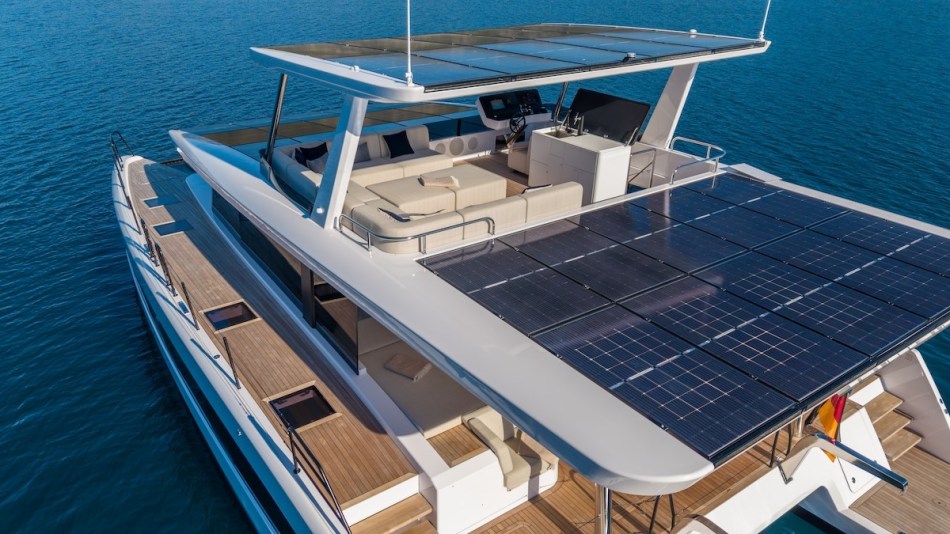
The expansive solar roof provides an installed peak capacity of 16.7 kWp. Beneath the decks, 246 kWh of battery storage supplies power for propulsion and domestic loads. The yacht’s preferred cruising speed lies between five and seven knots.
Frank says that under favourable conditions the yacht can effectively generate more energy than it consumes.
“In strong sun, up to 17kW per hour of solar energy is produced by the solar panels,” he explains. “At 5-7 knots with relatively flat seas, we only need about 5-15 kW per hour to push the boat and to make sure that all the hotel load is covered. In such situations, PY60 operates in an Energy-plus-mode which even gives us the possibility to charge the battery.”
Creating the interiors of Pioneer One
Micheletti + Partners, whose previous projects include work for Nautor’s Swan, Baltic Yachts, Bavaria Yachts and Italia Yachts, designed the main saloon. Here, warm timber surfaces sit alongside dark blue pinstriped wall finishes.
Large windows draw light deep into the space. Headroom reaches 2.1 metres in both the saloon and lower deck areas. Views remain a constant presence, reinforcing the connection between interior and seascape.
A dining and seating area occupies the aft section, while the main saloon forms the social core of the yacht. Direct access to both foredeck and aft deck strengthens the flow between indoor and outdoor living.
Outside, sun loungers on the foredeck provide a sheltered retreat underway or at anchor. On the flybridge, modular furniture transforms from sofa to sunbed as required.
Taken as a whole, Pioneer One is less concerned with reinventing yachting than refining it. The PY60 applies solar-electric propulsion to a platform specifically designed around long-term cruising rather than short coastal excursions.
What’s next for Pioneer Yachts?
A second PY60 is already under construction and is scheduled for delivery in summer 2027. Pioneer Yachts is also developing a charter version of the model. Future examples will increase battery capacity from 246 kWh to 288 kWh, providing additional energy reserves, and reducing reliance on shore-based infrastructure even further.
Buyers will be able to tailor materials, finishes and layouts to suit their requirements. Pioneer Yachts plans to build four units annually as the range develops.
Frank believes the format has considerable potential for premium cruising. The absence of a mast frees up deck space, while electric propulsion provides quiet operation and the speed required for relaxed coastal exploration.
Pioneer One makes a persuasive case for a different kind of yacht ownership: one built around measured cruising, generous living spaces and the ability to spend longer away from the marina.
Its appeal will be particularly clear to owners who value time at anchor and slow exploration of the Mediterranean. For them, a sunny day becomes more than an invitation to head out. It becomes the yacht’s power supply.
Cunard has unveiled its 2028-29 programme, featuring 93 voyages across 104 destinations in 49 countries. The collection includes visits to 64 UNESCO World Heritage Sites, with longer stays in port, 18 overnight calls and 18 late departures designed to give guests more time ashore. Standout itineraries include Queen Mary 2’s 500th Transatlantic Crossing, Queen Elizabeth’s…
Dubai’s reputation as an international dining destination continues to grow, with Atlantis Dubai retaining six Michelin stars across four restaurants in the 2026 Michelin Guide Dubai, alongside two individual awards and a new restaurant entry. The results were announced at the fifth edition of the Michelin Guide Dubai ceremony. They reaffirm the breadth of the…
For decades, luxury air travel has meant thinking big: A380s, private suites, champagne lounges, vast first-class cabins, even on-board showers. The next chapter though, could be about thinking smaller. It is very likely you will have flown on the A320 family of aircraft with BA or a budget airline, it’s the workhorse of European short-haul…



Stralsund-based boat builder, Pioneer Yachts, has unveiled the Pioneer One PY60 solar-electric catamaran, a next generation cruising yacht that places self-sufficiency at the centre of its design
Pioneer Yachts was founded by German engineer and entrepreneur Mike Frank after he recognised a gap in the market for a genuinely capable solar-electric yacht designed for continuous use at sea.
The 60-foot catamaran arrives as interest in quiet, low-maintenance cruising continues to grow. Rather than presenting solar-electric propulsion as a technological statement, Pioneer One approaches it as a practical tool for spending longer periods away from shore.
Designed around the owner’s established cruising habits, Pioneer One was conceived for extended voyages among the islands of Croatia, Greece and the Balearics, where Frank typically covers around 200 nautical miles each week. Every aspect of the layout supports a life spent travelling between anchorages rather than marinas.
Designed for Mediterranean cruising
The emphasis on practical autonomy extends beyond accommodation. During summer conditions, the yacht can generate up to 100 kWh of energy per day while its watermaker produces 100 litres of fresh water each hour. The vessel also incorporates the appliances and amenities required for prolonged independence afloat.
At the heart of the concept sits the PY60’s Integrated Energy Architecture. Rather than treating propulsion, power generation and storage as separate systems, Pioneer Yachts has designed them to operate together as a single coordinated network.
The expansive solar roof provides an installed peak capacity of 16.7 kWp. Beneath the decks, 246 kWh of battery storage supplies power for propulsion and domestic loads. The yacht’s preferred cruising speed lies between five and seven knots.
Frank says that under favourable conditions the yacht can effectively generate more energy than it consumes.
“In strong sun, up to 17kW per hour of solar energy is produced by the solar panels,” he explains. “At 5-7 knots with relatively flat seas, we only need about 5-15 kW per hour to push the boat and to make sure that all the hotel load is covered. In such situations, PY60 operates in an Energy-plus-mode which even gives us the possibility to charge the battery.”
Creating the interiors of Pioneer One
Micheletti + Partners, whose previous projects include work for Nautor’s Swan, Baltic Yachts, Bavaria Yachts and Italia Yachts, designed the main saloon. Here, warm timber surfaces sit alongside dark blue pinstriped wall finishes.
Large windows draw light deep into the space. Headroom reaches 2.1 metres in both the saloon and lower deck areas. Views remain a constant presence, reinforcing the connection between interior and seascape.
A dining and seating area occupies the aft section, while the main saloon forms the social core of the yacht. Direct access to both foredeck and aft deck strengthens the flow between indoor and outdoor living.
Outside, sun loungers on the foredeck provide a sheltered retreat underway or at anchor. On the flybridge, modular furniture transforms from sofa to sunbed as required.
Taken as a whole, Pioneer One is less concerned with reinventing yachting than refining it. The PY60 applies solar-electric propulsion to a platform specifically designed around long-term cruising rather than short coastal excursions.
What’s next for Pioneer Yachts?
A second PY60 is already under construction and is scheduled for delivery in summer 2027. Pioneer Yachts is also developing a charter version of the model. Future examples will increase battery capacity from 246 kWh to 288 kWh, providing additional energy reserves, and reducing reliance on shore-based infrastructure even further.
Buyers will be able to tailor materials, finishes and layouts to suit their requirements. Pioneer Yachts plans to build four units annually as the range develops.
Frank believes the format has considerable potential for premium cruising. The absence of a mast frees up deck space, while electric propulsion provides quiet operation and the speed required for relaxed coastal exploration.
Pioneer One makes a persuasive case for a different kind of yacht ownership: one built around measured cruising, generous living spaces and the ability to spend longer away from the marina.
Its appeal will be particularly clear to owners who value time at anchor and slow exploration of the Mediterranean. For them, a sunny day becomes more than an invitation to head out. It becomes the yacht’s power supply.
For more, visit Pioneer Yachts here.
Cunard unveils 93 new voyages headlined by Queen Mary 2’s 500th transatlantic crossing
Cunard has unveiled its 2028-29 programme, featuring 93 voyages across 104 destinations in 49 countries. The collection includes visits to 64 UNESCO World Heritage Sites, with longer stays in port, 18 overnight calls and 18 late departures designed to give guests more time ashore. Standout itineraries include Queen Mary 2’s 500th Transatlantic Crossing, Queen Elizabeth’s…
Atlantis Dubai retains six Michelin stars across four restaurants in 2026 guide
Dubai’s reputation as an international dining destination continues to grow, with Atlantis Dubai retaining six Michelin stars across four restaurants in the 2026 Michelin Guide Dubai, alongside two individual awards and a new restaurant entry. The results were announced at the fifth edition of the Michelin Guide Dubai ceremony. They reaffirm the breadth of the…
Introducing Airbus A321XLR: Why this new, small plane is changing luxury long haul travel
For decades, luxury air travel has meant thinking big: A380s, private suites, champagne lounges, vast first-class cabins, even on-board showers. The next chapter though, could be about thinking smaller. It is very likely you will have flown on the A320 family of aircraft with BA or a budget airline, it’s the workhorse of European short-haul…
Share this: