Japanese drinks are enjoying a moment. From the rise of matcha in coffee shops to the growing fascination with sake and the perennial prestige of Japanese whisky, international interest shows no signs of slowing.
Now gin, with its capacity for flavour innovation, is stepping into the spotlight.
The Kyoto Distillery, makers of Ki No Bi gin, is leading this charge. It was recently selected to represent Kyoto Prefecture at Expo 2025 Osaka. For Adrien Timpano, Head of Marketing, this was more than a chance to pour gin, it was a chance to tell Kyoto’s story.
“For Ki No Bi, beyond Japanese gin, our aim was to try and define what a Kyoto gin should be. And that means being always true and appreciative of the local heritage and origin, from ingredients to collaborators and suppliers with a long-standing history in Kyoto. What’s essential to us and what differentiates us from other brands is that we have a rich local brand story – sourcing and bonding with the community of artisans, craftsmen, and farmers – and we believe that’s what attracts gin fans locally and globally.”
The brand is currently showcasing its range to more than 28 million expected visitors…
A distinctly Japanese approach to gin
Launched in 2016, the name Ki No Bi translates as ‘the beauty of the seasons’, a philosophy that reflects every aspect of its production.
The brand forages for botanicals at the peak of their season (early summer for gyokuro green tea, peak of summer for the red shiso, beginning of winter for ginger and yuzu).
“Ki No Bi is deeply connected to Kyoto’s terroir,” Timpano explains. “We use pure Fushimi water, which has been prized by sake brewers for centuries, and we source botanicals directly from the region. The aim is not just to make gin, but to bottle the essence of Kyoto itself.”
Each botanical is distilled separately in six groups – base, citrus, tea, herbal, spice, and floral – before being blended. It’s an approach that echoes the meticulous traditions of kaiseki cuisine.
“Our Master Distiller noticed that not all botanicals require the same distillation to deliver their finest quality and aromas. We grouped our 11 botanicals into 6 different groups and we distill them separately. We end up with 6 different distillates that we then blend to obtain our final liquid, Ki No Bi Kyoto Dry Gin.”
The approach also provides a nice base for experimentation and innovation, confides Timpano, allowing the team to play with the different elements.
Just don’t expect easy access to any limited or experimental expressions. “We want to keep them really exclusive indeed, with liquids that will please connoisseurs and push the boundaries of what a gin can be with rare casks ageing and finishes.”
In the glass: tasting Ki No Bi
Ki No Bi is a gin that feels both familiar and distinctly Japanese. Bottled at 45.7% abv, it uses a rice spirit base. On the nose, there’s bright yuzu zest, lifted by a clean, green freshness. Sanshō pepper adds a prickle of spice.
On the palate, there’s the texture derived from the rice spirit base, which Timpano describes as “giving a silkiness you don’t find in many gins.” The citrus carries through, but it’s grounded by umami depth from gyokuro tea. Bamboo leaves bring a mineral freshness, while ginger adds warmth.
The finish lingers, soft and rounded , a reflection of Fushimi’s famously soft water. It’s less juniper-led than a classic London Dry, but every bit as structured.
“We believe our blending water from Fushimi, provided by renowned sake producer Masuda Tokubee Shoten, plays an important role as much as any of our other botanicals,” explains Timpano. “The water we use is pure, mild and naturally soft sourced from one of the oldest sake breweries in Fushimi area which is known as a high-quality sake in Kyoto. We simply blend the water as is upon filtration in order to extract its finest quality to the fullest which gives Ki No Bi its clean and mild mouthfeel.”
Those lucky enough to visit Expo Osaka this June, discovered Ki No Bi’s flagship gin, alongside its siblings, Ki No Tea and Ki Bi Sei.
“Expo is about sharing culture,” he says. “Japanese whisky showed the world that Japan can reinterpret a Western tradition with craftsmanship and subtlety. We believe gin can do the same.”
The prize is significant. The global gin market is projected to surpass $22 billion by 2030, with fans increasingly seeking out small-batch, locally flavoured spirits.
“The rise of craft distillers has ignited a wave of Japanese spirits launches. Brands are taking classically beloved Western spirits but adding a local Japanese twist by using local ingredients and flavours and this is what is driving so much enthusiasm in countries like the UK and in the rest of Europe,” says Timpano.
English sparkling wine has come of age. Popping corks to celebrate two decades of production, Gusbourne recently held a unique tasting of 13 vintages from the last 20 years, including an extremely rare sampling of its 2006 bottling. The idea behind the retrospective was to examine the evolution of its sparkling wines, vineyards, and winemaking…
Monkey 47 has revealed oyster mushroom as the unusual 48th botanical in its latest limited-release Distiller’s Cut gin, bringing savoury umami notes to its traditional Black Forest spirit. Now in its 16th year, the annual Distiller’s Cut sees Monkey 47 search for a Species Rara: an exceptional ingredient that adds a new dimension to its…
The Borders Distillery in Hawick has unveiled its first single malt, marking the return of whisky production to the Scottish Borders for the first time since 1837. Limited to 10,000 bottles, the eight-year-old inaugural release has been matured in first-fill bourbon casks and finished in Malmsey Madeira casks. For managing director Giancarlo Bianchi, this debutant…

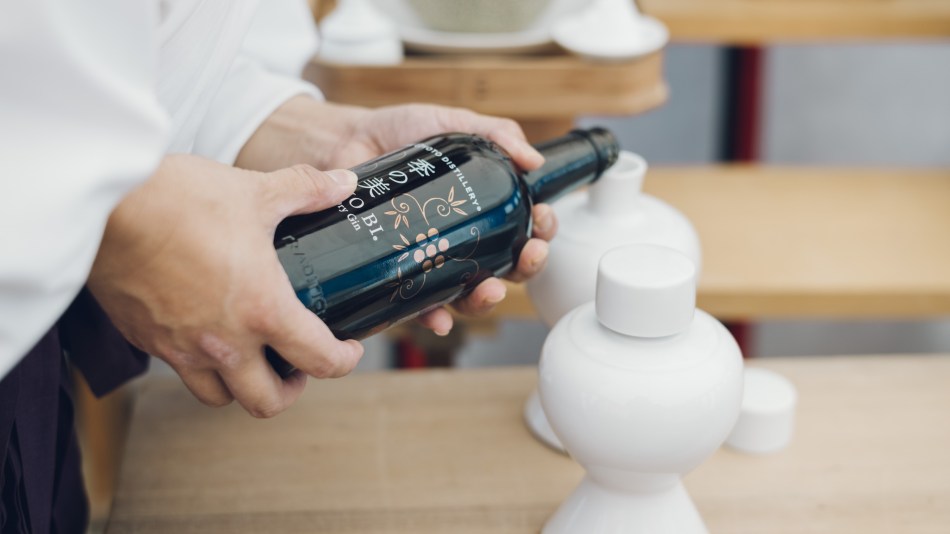


Japanese drinks are enjoying a moment. From the rise of matcha in coffee shops to the growing fascination with sake and the perennial prestige of Japanese whisky, international interest shows no signs of slowing.
Now gin, with its capacity for flavour innovation, is stepping into the spotlight.
The Kyoto Distillery, makers of Ki No Bi gin, is leading this charge. It was recently selected to represent Kyoto Prefecture at Expo 2025 Osaka. For Adrien Timpano, Head of Marketing, this was more than a chance to pour gin, it was a chance to tell Kyoto’s story.
“For Ki No Bi, beyond Japanese gin, our aim was to try and define what a Kyoto gin should be. And that means being always true and appreciative of the local heritage and origin, from ingredients to collaborators and suppliers with a long-standing history in Kyoto. What’s essential to us and what differentiates us from other brands is that we have a rich local brand story – sourcing and bonding with the community of artisans, craftsmen, and farmers – and we believe that’s what attracts gin fans locally and globally.”
A distinctly Japanese approach to gin
Launched in 2016, the name Ki No Bi translates as ‘the beauty of the seasons’, a philosophy that reflects every aspect of its production.
The brand forages for botanicals at the peak of their season (early summer for gyokuro green tea, peak of summer for the red shiso, beginning of winter for ginger and yuzu).
“Ki No Bi is deeply connected to Kyoto’s terroir,” Timpano explains. “We use pure Fushimi water, which has been prized by sake brewers for centuries, and we source botanicals directly from the region. The aim is not just to make gin, but to bottle the essence of Kyoto itself.”
Each botanical is distilled separately in six groups – base, citrus, tea, herbal, spice, and floral – before being blended. It’s an approach that echoes the meticulous traditions of kaiseki cuisine.
“Our Master Distiller noticed that not all botanicals require the same distillation to deliver their finest quality and aromas. We grouped our 11 botanicals into 6 different groups and we distill them separately. We end up with 6 different distillates that we then blend to obtain our final liquid, Ki No Bi Kyoto Dry Gin.”
The approach also provides a nice base for experimentation and innovation, confides Timpano, allowing the team to play with the different elements.
Just don’t expect easy access to any limited or experimental expressions. “We want to keep them really exclusive indeed, with liquids that will please connoisseurs and push the boundaries of what a gin can be with rare casks ageing and finishes.”
In the glass: tasting Ki No Bi
Ki No Bi is a gin that feels both familiar and distinctly Japanese. Bottled at 45.7% abv, it uses a rice spirit base. On the nose, there’s bright yuzu zest, lifted by a clean, green freshness. Sanshō pepper adds a prickle of spice.
On the palate, there’s the texture derived from the rice spirit base, which Timpano describes as “giving a silkiness you don’t find in many gins.” The citrus carries through, but it’s grounded by umami depth from gyokuro tea. Bamboo leaves bring a mineral freshness, while ginger adds warmth.
The finish lingers, soft and rounded , a reflection of Fushimi’s famously soft water. It’s less juniper-led than a classic London Dry, but every bit as structured.
“We believe our blending water from Fushimi, provided by renowned sake producer Masuda Tokubee Shoten, plays an important role as much as any of our other botanicals,” explains Timpano. “The water we use is pure, mild and naturally soft sourced from one of the oldest sake breweries in Fushimi area which is known as a high-quality sake in Kyoto. We simply blend the water as is upon filtration in order to extract its finest quality to the fullest which gives Ki No Bi its clean and mild mouthfeel.”
Those lucky enough to visit Expo Osaka this June, discovered Ki No Bi’s flagship gin, alongside its siblings, Ki No Tea and Ki Bi Sei.
“Expo is about sharing culture,” he says. “Japanese whisky showed the world that Japan can reinterpret a Western tradition with craftsmanship and subtlety. We believe gin can do the same.”
The prize is significant. The global gin market is projected to surpass $22 billion by 2030, with fans increasingly seeking out small-batch, locally flavoured spirits.
“The rise of craft distillers has ignited a wave of Japanese spirits launches. Brands are taking classically beloved Western spirits but adding a local Japanese twist by using local ingredients and flavours and this is what is driving so much enthusiasm in countries like the UK and in the rest of Europe,” says Timpano.
Ki No Bi Kyoto Dry Gin is available from The Whisy Exchange, priced £48.50.
Beyond Champagne: Why Gusbourne Is leading England’s sparkling wine revolution
English sparkling wine has come of age. Popping corks to celebrate two decades of production, Gusbourne recently held a unique tasting of 13 vintages from the last 20 years, including an extremely rare sampling of its 2006 bottling. The idea behind the retrospective was to examine the evolution of its sparkling wines, vineyards, and winemaking…
Monkey 47 Distiller’s Cut 2026 adds oyster mushroom to gin recipe for savoury umami twist
Monkey 47 has revealed oyster mushroom as the unusual 48th botanical in its latest limited-release Distiller’s Cut gin, bringing savoury umami notes to its traditional Black Forest spirit. Now in its 16th year, the annual Distiller’s Cut sees Monkey 47 search for a Species Rara: an exceptional ingredient that adds a new dimension to its…
The Borders Distillery Eight Year Old inaugural whisky builds on cashmere and tweed heritage
The Borders Distillery in Hawick has unveiled its first single malt, marking the return of whisky production to the Scottish Borders for the first time since 1837. Limited to 10,000 bottles, the eight-year-old inaugural release has been matured in first-fill bourbon casks and finished in Malmsey Madeira casks. For managing director Giancarlo Bianchi, this debutant…
Share this: